



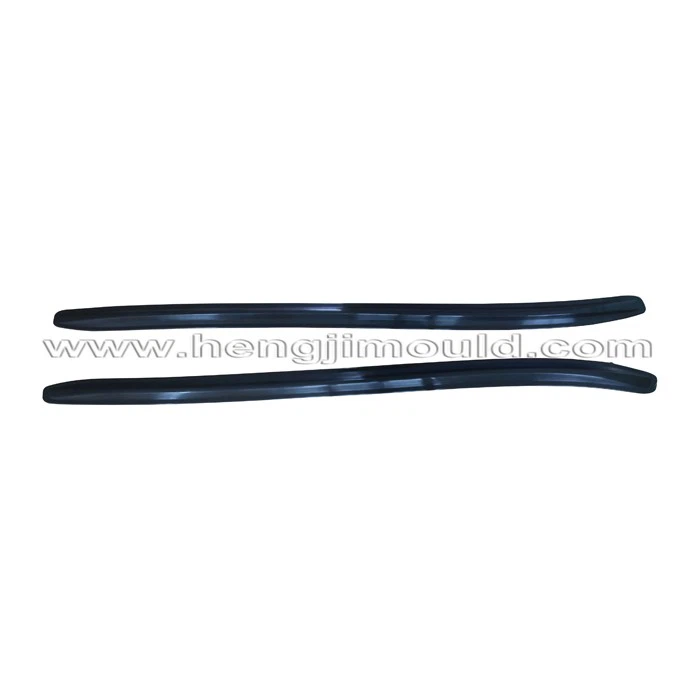
Roof Molding Mould
Automotive Headliner Interior Design & Process
The automotive headliner uses thermoplastics which is noise and heat resistance and is also decorative and protective. As it is one of the most significant interiors, design is very important. There are auto ceiling control platform, sun visor, armrest, air conditional cowl, harness, energy absorbing unit, noise&heat insulating unit, reading light and other electrical equipment.
Construction
There are soft material and hard material car roofs and the soft one is to make lining and foam layer composed by layer press or flame, while the hard one is injection molded with lining and base part, then as customer required choices to have non woven fabric at backside or protecting layer over lining.
Generally there are lining, base part and non woven fabric for a vehicle ceiling and in which the lining reveals appearance by fabrics. The base part represents the headliner function and always made by composition of PU glass fiber plate, PP glass fiber plate.
Molding process and assembly
The main body of headliner applies compression molding that put sheet material into mold cavity then heat and compress to make it solid. To use high compressed water cut or cut on mold to make the headliner outline and holes.
The assembly fixed positions located at armrest, sunshade, central control, roof light or 2~3 plastic clips, nylon buckle and magnet for self-fixation if rear roof lights not given. The assembly order could be rear-sunshade-roof light-roof moulding-armrest-interior trim while the rear assembly position and sunshade assembly position are set as the datum.
Production Process -there are two methods
“Dry” Process
It is a relatively simpler way but cost much more which is suitable for less labor cost product that raw material is directly purchased and left assembly, cut and molding. First is the compression molding that control the temperature around 200 degree and heat time less than 2 minutes. Mold close pressure should be around 15Mpa and packing time about 1 min. Second is the cut using high pressure water that put the product at the platform and after programming the robot do the cutting.
“Wet” Process
There are one-step process and two-step process. For the former, get polyurethane sheet surface fully applied with adhesive and then spray curing agent and water to make glass mat, film and lining layered as a composition. Next to put the composition into high temperature mold for molding while the temperature depends on glue solidification value. Lastly water cutting machine to cut the edges left by product shape.
For two-step process, get polyurethane sheet surface fully applied with adhesive and then spray curing agent and water to make glass mat and bottom layer non woven cloth as a composition. Next to put the composition into high temperature mold for molding into preliminary shape, then use water cutting machine to cut the edges. After spraying adhesive on the surface to add lining, do molding and cutting again. The production efficiency is lower than that of the former but it can provide product with negative draft angle and turn-up lining.
The “dry” process has higher production efficiency and environment-friend. It can be recycled and has better appearance but cost much higher for raw material use which is suitable for roofs with relatively simple and lower drawing depth. While the “wet” process is just in contradiction.
Hot Tags: roof molding mould, China roof molding mould manufacturers, makers, exterior molding, Plastic Side Skirt Trim Moulding, Rear View Mirror Mould, Roof Molding Mould
You Might Also Like


Send Inquiry